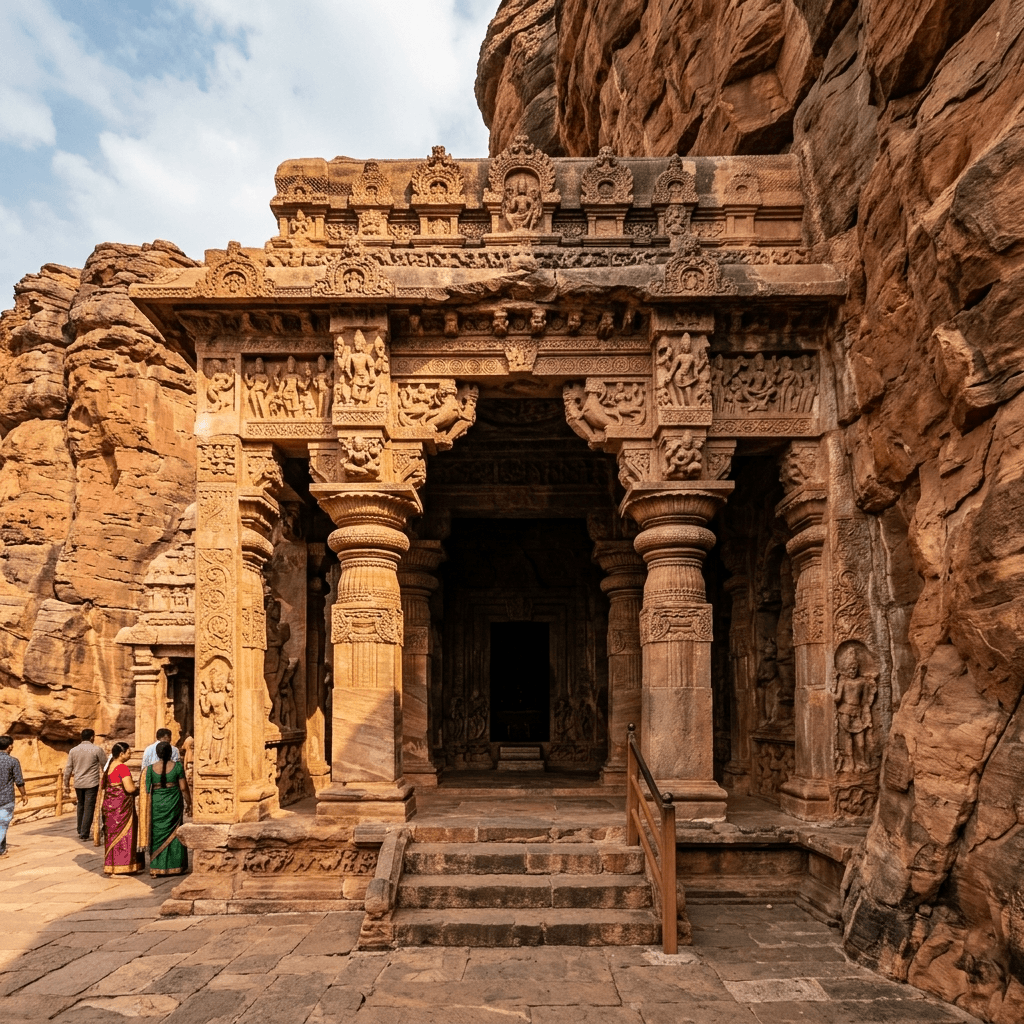
Badami
Badami – Chalukya Cave Temples
The Badami cave temples are a complex of Hindu and Jain temples carved into the red sandstone cliffs by the Chalukya dynasty, representing some of India's earliest rock-cut architecture.
Four Caves
Three Hindu caves and one Jain cave, each with distinct iconography
Vishnu Trivikrama
A massive 5-meter carving of Vishnu in the cosmic three-stride pose
Agastya Lake
The sacred tank surrounded by 7th-century temples
Synthesized Insight
AI NARRATIONBadami caves represent a key transitional moment in Indian temple architecture — the evolution from rock-cut to structural temples. The Chalukyas essentially used Badami as a laboratory for developing the Dravidian architectural grammar.
Timeline
543 CE
Pulakesi I establishes Vatapi (Badami) as capital
578 CE
Cave 3 — the largest — dedicated to Vishnu
634 CE
Pulakesi II expands the empire; new temples commissioned
757 CE
Rashtrakutas capture Badami
Digital Twin
PROTOTYPEExplore a photogrammetric 3D reconstruction of Badami through VIVIDH's spatial computing platform.